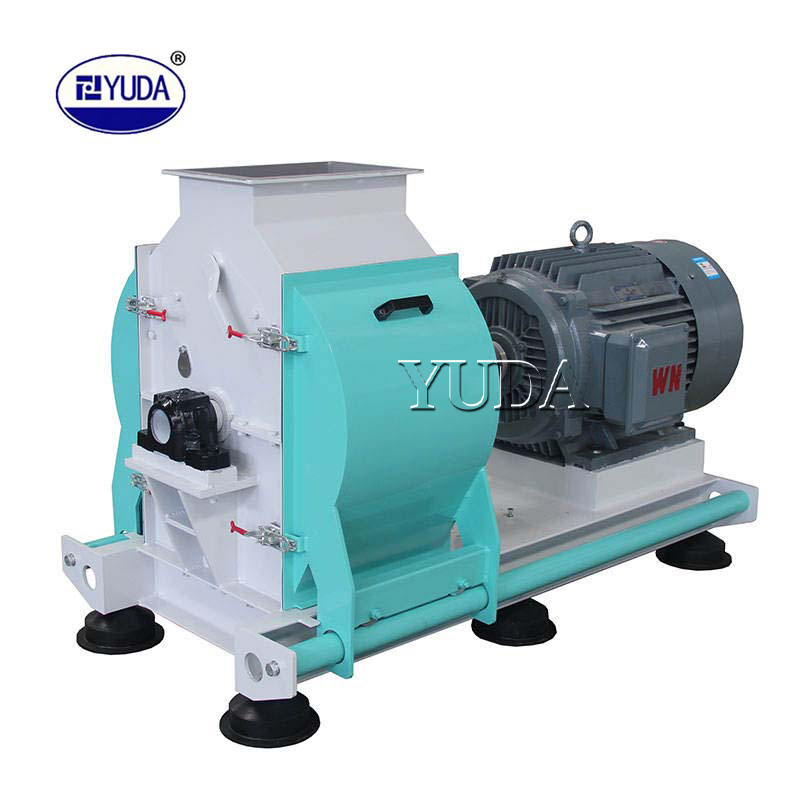
The SFSP66X100 hammer mill carries ten design features, and five of them come with patent numbers. Two of the ten name the same target directly: the circulation layer, a ring of already-ground material that spins with the rotor along the screen and quietly caps hammer mill grinding efficiency. On paper the series looks like a simple ladder of sizes, from 4–12 t/h at the smallest model to 15–56 t/h at the largest. In practice, what separates a mill that hits its rated output from one that stalls below it is often what happens inside the chamber, not the motor size. This article explains the circulation layer, shows which SFSP66 features work against it, and lists what to check before you buy.
If a hammer mill runs below its rated output even though the motor, hammers, and screen all look fine, suspect the circulation layer before you suspect anything else. The layer covers the screen's open area, so fine particles that could leave the chamber cannot reach the holes. The SFSP66 series attacks the problem from several sides at once: a fixed knife, axial air supplement, a top toothed plate with an adjustable material stop, and an adjustable hammer-screen gap. No single feature is the whole answer, which is why it pays to understand each one.
A hammer strikes a particle at very high speed, and the particle leaves the impact moving almost as fast as the hammer tip. Centrifugal force then pushes it out against the screen. If the particle is small enough and reaches a hole, it leaves. If not, it rides along the screen surface in the direction of rotation. As more particles pile in, this moving ring thickens. That ring is the circulation layer: material that has already been ground, is not yet through the screen, and now blocks the path for everything behind it.
A useful picture is a crowd circling a revolving door. People who want to leave keep walking around the door instead of through it, and the crowd behind them cannot get near it. In a hammer mill, the practical effects are the same in three ways: lower throughput because the screen's open area is partly covered, higher energy per ton because fine material is struck again and again, and hotter product for the same reason. The layer is a well-documented effect in hammer mill research, not a marketing term.
Two features name the circulation layer outright: the fixed knife and the axial air supplement. The others improve efficiency, rigidity, wear life, or service access. The table lists all ten, with the patent number where the manufacturer gives one.
| Feature | Patent No. | Function |
|---|---|---|
| Multi-chamber structure | ZL202410991869.0 | More uniform grinding, higher efficiency |
| Integral rotor with expansion sleeve locking | ZL20241758423.5 | Rigidity; prevents loosening and shaft runout |
| Scientific hammer arrangement | ZL202421752275.6 | Different combinations give different grinding effects |
| Fixed knife in the chamber | ZL202421857947.X | Breaks the circulation layer |
| Linked screen pressing mechanism | ZL2024219503209 | Easier, more reliable screen replacement |
| Top toothed plate and adjustable material stop | — | Raises grinding efficiency |
| Adjustable hammer-screen gap | — | Matches fineness needs of different materials |
| Axial air supplement | — | Breaks the circulation layer, helps screening |
| Material guide reversing plate | — | Rotor runs forward and reverse, extending wear life |
| Mobile door with safety interlock | — | Convenient and safe door opening |
The fixed knife is a stationary element mounted in the grinding chamber. Because it does not move with the rotor, material riding around the chamber runs into it and loses its circular path. That interruption breaks the ring apart and sends particles back toward the hammers or toward open screen area. It is the mechanical answer to the problem.
The axial air supplement is the airflow answer. Air enters along the rotor's axis and loosens the material near the screen, which helps fine particles find the holes. The two work well together: one interrupts the ring, the other thins it. The top toothed plate and the adjustable material stop add a third check on material flow inside the chamber.
The rotor spins at 2,960 r/min with a hammer line speed of 102 m/s, so looseness or shaft runout shows up fast as vibration and uneven wear. The series uses an integral high-precision rotor locked with an expansion sleeve to keep it rigid and stop it working loose. Steady rotation also keeps the hammer-screen gap consistent, and that gap is one of the main settings that decides fineness.
Hammers wear mostly on one leading edge. Because the material guide reversing plate lets the rotor run in either direction, the mill can use the opposite edge once the first one wears, which the manufacturer says greatly extends the life of wearing parts. In practical terms, that means fewer hammer changes and less downtime between them.
All six models share the same 660 mm rotor, the same 2,960 r/min spindle speed, and the same 102 m/s hammer line speed. What changes is grinding width, and everything follows from it: hammer count, motor power, weight, and capacity.
| Model | Capacity (t/h) | Power (kW) | Grinding Width (mm) | Hammers (pcs) | Weight (kg) | Dimensions L×W×H (mm) |
|---|---|---|---|---|---|---|
| SFSP66X60 | 4-12 | 55/75 | 620 | 72 | 2876 | 2240×1360×1470 |
| SFSP66X80 | 6-18 | 90/110 | 810 | 96 | 3616 | 2600×1360×1470 |
| SFSP66X100 | 8-26 | 132/160 | 1000 | 120 | 3880.8 | 2800×1360×1470 |
| SFSP66X120 | 10-36 | 160/200/220 | 1200 | 144 | 4366 | 3000×1360×1470 |
| SFSP66X140 | 15-50 | 220/250/315 | 1400 | 168 | 5364 | 3500×1360×1470 |
| SFSP66X150 | 15-56 | 250/315/355 | 1526 | 184 | 5800 | 3600×1360×1470 |
Throughput below the rated figure usually traces to one of four causes: raw material moisture above the 12–14% the ratings assume, a partly blinded screen, worn hammers that have widened the hammer-screen gap, or a feed rate that thickens the circulation layer. Check the first three before you touch the feeder, then reduce the feed rate slightly and watch whether output rises.
Product coarser than the screen size suggests points to a worn or damaged screen, or a hammer-screen gap that has drifted too wide. Inspect the screen for tears and measure the gap before you swap to a finer screen, because a finer screen on a worn mill often just lowers throughput.
Vibration or noise that was not there before often follows a hammer change done unevenly. Replace hammers in balanced sets, and confirm the rotor is still locked tight on its expansion sleeve before you look for other causes.
Hot product at the outlet can mean the mill is re-grinding material already fine enough to leave. Look at the feed rate, the screen condition, and whether the air path is clear, since all three affect how long fine material stays in the chamber.
Treat the rated capacity as a corn figure, not a universal one. The table note states that ratings assume maize at 12–14% moisture or below. Fibrous, oily, or damper materials will not reach the same output, so ask the supplier what your specific formula should deliver on the model you are considering.
Check whether the screen range covers your target. The series takes φ1–3 mm screens, which suits coarse to medium feed grinds. If your product needs a much finer powder than a 1 mm screen can deliver, a screen-based hammer mill is the wrong tool, and a separate ultrafine stage is worth a look.
Plan your spares by the hammer count. An SFSP66X100 carries 120 hammers, and you will replace them in sets. Ask the supplier to confirm the power option that suits your target fineness too, because each model lists several power options rather than a single figure. Finally, ask for the documentation behind the patent numbers if patented features are part of your buying reason.
Not necessarily. If the circulation layer is what limits output, more power mostly spins the layer faster instead of clearing the screen. Check moisture, screen condition, hammer wear, and feed rate first. Chamber features that break the layer, such as a fixed knife and axial air, address the cause more directly than added kilowatts do.
Yes. The material guide reversing plate is built for it. Running the rotor in reverse presents the hammers' second edge to the material once the first edge wears, which extends the life of the wearing parts. Follow the supplier's procedure when you switch direction so the mill stays balanced and safe.
The series lists screen holes of φ0.8–3 mm. Choose within that range according to the fineness your feed formula needs, and adjust the hammer-screen gap to match the material you are grinding.
Look for the pattern: output that stops rising when you increase the feed rate, product temperature that climbs, and energy per ton that gets worse, all while the screen and hammers are in good condition. When those signs appear together, the layer is a likely cause, and it is worth asking how the chamber design deals with it.
Written by: Yuda Machinery Engineering Team
Based on years of experience in feed machinery manufacturing, equipment design and overseas project installation.
Supply feed, fertilizer & biomass core equipment and full turnkey lines. Factory area: 34,500 sq.m. Exported to 70+ countries.

 Tel: 0086-519-87905108
 Email: yudagrace@yudamachinery.com
Fax: 0086-519-87909696
Add: No. 10, Zengjia Road, Liyang, Jiangsu, China.
Copyright ©2023 Liyang Yuda Machinery Co.,Ltd. All rights reserved.
Privacy


 inquiry Now

 English
 Español
 عربى
 Français
 русский