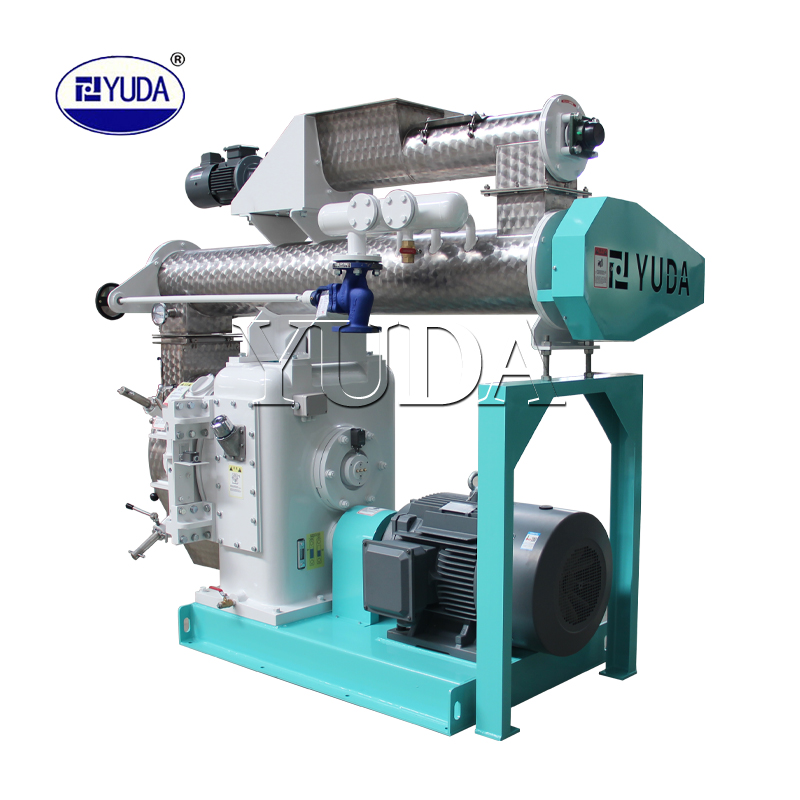
If your raw material is rice husk, bamboo shavings, or hardwood chips, and you need to balance output, power cost, and long-term wear all at once, the MZLH (W) series biomass pellet mill belongs on your shortlist. It's a ring-die pellet mill, an extrusion-type pelleting equipment. The crushed raw materials enter the inner cavity of the rotating ring-die. Press rollers installed inside the ring-die compress materials and force them through die holes to form pellets — with capacity spanning 0.6 to 3.2 tons per hour across six models, built to match everything from a small wood-waste processing point to a mid-size biomass fuel plant.
Picking the right MZLH (W) model comes down to matching your target hourly output against the machine's rated range, then confirming the forced feeder power is enough for your specific material's bulk density. Get either one wrong, and low-density material like rice husk won't feed into the compression chamber fast enough, or the machine runs underloaded and you pay for power without the matching output.
The ring-die pellet mill uses internally-mounted rollers inside the rotating ring-die to press crushed raw material through die holes for pellet formation. With a relatively long compression path inside die holes, the material is fully compacted, delivering pellets with uniform density and stable forming performance. For biomass fuel pellets, pellet density has a major impact on combustion consistency and pellet durability. This structural feature determines whether pellets can remain intact during transportation and bag-storage, or break into powder inside bags.
The series is built around six models — MZLH400, MZLH420, MZLH508, MZLH558, MZLH678, and MZLH768 — with hourly capacity climbing from 0.6 tons to 3.2 tons as main motor power scales from 75KW up to a 250KW range. Feeder and forced feeder power step up together at the larger end of the series: the 508 and 558 models run a 3KW feeder with a 1.5KW forced feeder, while the 678 and 768 step up to a 4KW feeder with a 2.2KW forced feeder. Pellet output across the whole series is standardized at Φ6, Φ8, and Φ10mm, with custom apertures available on request.
| Model | Capacity (T/H) | Main motor power (kW) | Broken arch feeder power (kW) | Forced feeder power (kW) | Pellet standard (mm) |
|---|---|---|---|---|---|
| MZLH400 | 0.6-0.9 | 75 | 3 KW | 1.1 KW | Φ6 Φ8 Φ10 |
| MZLH420 | 1-1.3 | 110 | 3 KW | 1.1 KW | Φ6 Φ8 Φ10 |
| MZLH508 | 1.4-1.8 | 160 KW | 3 KW | 1.5 KW | Φ6 Φ8 Φ10 |
| MZLH558 | 1.8-2.1 | 185 KW | 3 KW | 1.5 KW | Φ6 Φ8 Φ10 |
| MZLH678 | 2.1-2.5 | 200 KW | 4 KW | 2.2 KW | Φ6 Φ8 Φ10 |
| MZLH768 | 2.5-3.2 | 250 KW | 4 KW | 2.2 KW | Φ6 Φ8 Φ10 |
There's a clear step between the MZLH508 and MZLH768: capacity nearly doubles, and both feeder power and forced feeder power move up a full tier together. This is worth flagging during budgeting — the mid-to-large step in this series is a genuine equipment-class change with real added feeding capability, not just a bigger motor.
The official application range for this series covers straw, rice husk, bamboo shavings, and oak (hardwood) chips — four materials that sit at very different points on the fiber-toughness and bulk-density spectrum. Straw and husk are light and low-density, which is exactly why the forced feeder is standard on every model in the series; bamboo and oak are denser and more fibrous, which places more demand on the die's wear resistance over time — an area where the series' purpose-built ring die and press roller design is engineered to hold up.
Because the material mix a plant actually processes can vary a lot — some run pure rice husk, others blend straw with hardwood offcuts — it's worth sending an actual material sample to the supplier along with the target hourly output before finalizing a model, so the die aperture and forced feeder configuration can be confirmed against the real feedstock rather than a generic spec sheet.
Start by converting your target daily output into an hourly figure, then aim for a model where that number sits in the middle of its rated range rather than right at the ceiling — that leaves headroom for the batch-to-batch variation in moisture and fiber content that biomass feedstock naturally brings.
If low-density material like rice husk or straw makes up most of your feed mix, don't stop at overall capacity — check that the forced feeder power tier matches, since that component determines whether material actually reaches the compression chamber at the rate the main motor is capable of processing.
Finally, confirm with the supplier whether the standard Φ6/Φ8/Φ10 pellet aperture set covers your downstream use case, or whether a custom die is needed — household heating stoves, industrial boilers, and export pellet markets each tend to favor their own pellet diameter, and it is far easier to specify this correctly before the order ships than to retrofit afterward.
The series covers 0.6 to 3.2 tons per hour across MZLH400, MZLH420, MZLH508, MZLH558, MZLH678, and MZLH768. Capacity and main motor power rise together at each step, and the feeder/forced feeder power tier changes once, between the MZLH558 and MZLH678, reflecting a real jump in feeding capability rather than a purely incremental upgrade.
Yes. The standard configuration covers Φ6, Φ8, and Φ10mm dies, and other apertures can be customized to match specific downstream requirements, such as different combustion equipment or export market specifications.
The strong magnetic security device pulls metal debris such as iron filings and screws out of the material stream before it reaches the die and rollers. If pressure inside the chamber still spikes beyond a safe range, the overload protective device shuts the machine down automatically, and the outside-machine discharging mechanism lets operators clear the blockage from outside the housing, which keeps the actual downtime short.
Convert your daily output target into an hourly figure and match it against the spec table, choosing a model that covers that range with headroom to spare. Then check whether your feedstock's bulk density calls for the higher forced feeder power tier. Finally, confirm the pellet aperture options fit your downstream use. Sending this information, along with a material sample, to the supplier sharpens the sizing decision and lowers the risk of the machine falling short after delivery.
Supply feed, fertilizer & biomass core equipment and full turnkey lines. Factory area: 34,500 sq.m. Exported to 70+ countries.

 Tel: 0086-519-87905108
 Email: yudagrace@yudamachinery.com
Fax: 0086-519-87909696
Add: No. 10, Zengjia Road, Liyang, Jiangsu, China.
Copyright ©2023 Liyang Yuda Machinery Co.,Ltd. All rights reserved.
Privacy


 inquiry Now

 English
 Español
 عربى
 Français
 русский