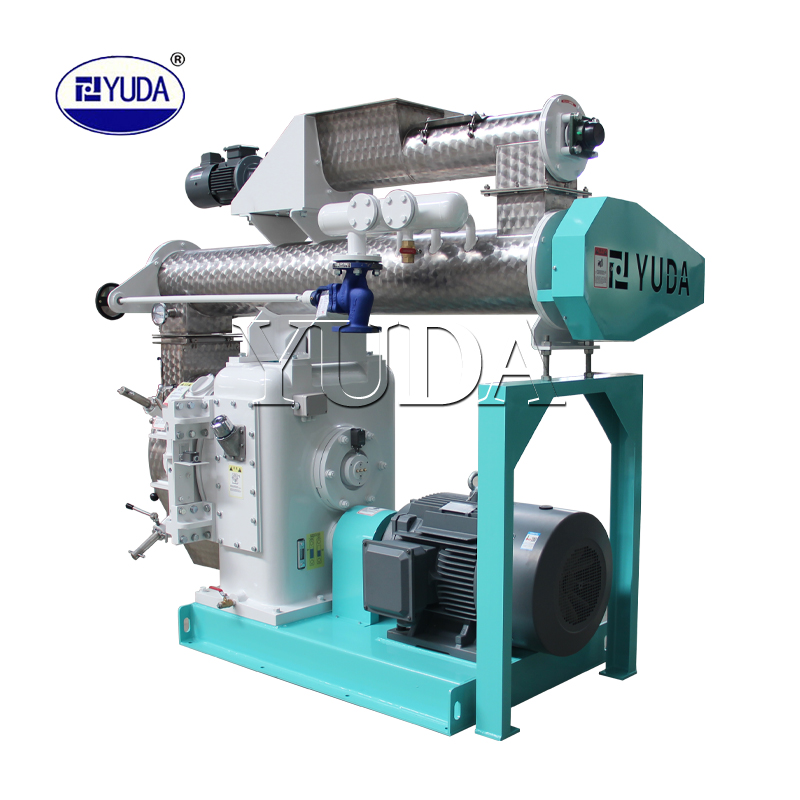
If your feed mill is planning for an annual single-shift output in the tens of thousands of tons, and the pelleting stage is the bottleneck holding that plan back, the SZLH series feed pellet mill is built for exactly that scale. This is a ring-die pellet mill. After conditioning, material enters the inner cavity of the ring die and is extruded outwards through die holes by internal rollers for pellet formation. It is specially designed for medium-to-large-scale feed plants. Three models — SZLH558, SZLH678 and SZLH768 — cover capacity from 20 t/h to 35 t/h. Under single-shift operation, the base-model annual capacity reaches 40,000-70,000 tons (based on livestock and poultry compound feed, 8-hour single shift, 250 working days per year. Actual capacity is subject to formula and operating conditions).
For a plant already operating at large or medium scale, the deciding factor across SZLH558, SZLH678, and SZLH768 isn't which model has the biggest motor — it's which model's rated capacity range matches your actual shift output plan, because conditioner power and ring die diameter scale together with capacity, and buying ahead of real demand means paying for conditioning capacity you won't use yet.
The ring-die pellet mill is driven by a motor to rotate the ring die. After conditioning, the feed material is fed into the gap between the ring die and rollers. Subjected to relative compression between the ring die and rollers, the material is forced through the die holes for pellet formation, while the rollers rotate passively by friction from feed material.
With a relatively long compression path inside die holes, the material gets sufficiently compressed, producing pellets with uniform density and stable forming rate. Low pellet density will lead to a high pulverization rate. Pellets tend to break and turn into powder during transportation and storage, which directly affects the finished-product acceptance rate highly valued by large-scale feed mills.
The three models scale together in a consistent pattern: as ring die diameter grows from 572mm to 762mm, capacity rises from 17-20 T/H to 25-32 T/H, and conditioner power steps up from 7.5KW to 11KW to keep pace with the larger throughput. Feeder power moves from 2.2KW on the SZLH558 to 3KW on the two larger models, and pellet size is standardized at φ2-10mm across the whole line.
| Model | Motor power (kW) | Feeder power (kW) | Conditioner power (kW) | Dia. of Ring Die (mm) | Pellet Size (mm) | Capacity (t/h) | Dimension (mm) | Net weight (kg) |
|---|---|---|---|---|---|---|---|---|
| SZLH558 | 185/200 | 2.2 | 7.5 | 572 | φ2-10 | 17-22 | 4700×1600×4900 | 5500 |
| SZLH678 | 200/220/250 | 3 | 11 | 673 | φ2-10 | 20-26 | 4800×1600×5300 | 8000 |
| SZLH768 | 250/280/315 | 3 | 11 | 762 | φ2-10 | 25-35 | 4800×1600×5300 | 8500 |
Net weight also tells a clear story: the SZLH558 comes in at 5,500KGS, while both the SZLH678 and SZLH768 jump to 8,000KGS and 8,500KGS. That near-doubling in weight reflects a heavier, more reinforced gear transmission box built to handle sustained operation at the higher end of the capacity range — a structural upgrade, not just a bigger footprint.
This series is engineered specifically for large and medium-scale feed production facilities aiming for premium-quality pelletized feed at scale. The compact yet sturdy structure and aesthetically optimized design combine operational reliability with straightforward installation and maintenance access, which matters when a plant is running the pelleting line continuously across shifts rather than intermittently.
With a single-shift annual capacity of 34,000 to 44,000 tons on the base SZLH558 model, and two larger models available for facilities that need to go beyond that range, the series gives a growing feed mill room to scale up within the same product family rather than switching platforms as demand increases.
Start with your realistic shift output target, not your aspirational one, and match it against the capacity range where it sits comfortably in the middle rather than at either edge — SZLH558 for 17-22 T/H, SZLH678 for 20-26 T/H, SZLH768 for 25-35 T/H.
If your feed mill has a concrete expansion plan for the next one to two years, sizing up a tier to build in headroom can make sense, since the reinforced transmission box and higher conditioner power on the larger models are built for exactly that kind of sustained higher-throughput operation. If output is expected to stay stable, the model whose range covers your target directly is the more efficient buy — there's no need to pay for conditioning and drivetrain capacity you won't use for years.
The base SZLH558 model is designed to deliver a single-shift annual capacity of 34,000 to 44,000 tons, with the SZLH678 and SZLH768 models scaling further upward for larger operations that need to exceed that range.
Match your realistic hourly shift output against the three capacity ranges — 17-22T/H, 20-26T/H, and 25-35 T/H — and choose the model where your target sits comfortably in the middle. If a concrete expansion plan is already in place, sizing up a tier for headroom is worth the added conditioner and drivetrain capacity that comes with it.
Conditioner power scales from 7.5KW on the SZLH558 to 11KW on the SZLH678 and SZLH768 because conditioning has to keep pace with a larger volume of material moving through the line per hour. Matching conditioner capacity to throughput is what keeps pellet formation consistent at higher output levels, rather than letting quality slip as volume goes up.
No — the quick-opening extended cleaning door, spherical door cover, and multi-directional adjustment door shaft are standard across the whole series, so cleaning and maintenance access stays dead-corner free and straightforward regardless of which model is running. The larger models simply carry a reinforced transmission box to match their higher throughput, without changing how maintenance is performed day to day.
Supply feed, fertilizer & biomass core equipment and full turnkey lines. Factory area: 34,500 sq.m. Exported to 70+ countries.

 Tel: 0086-519-87905108
 Email: yudagrace@yudamachinery.com
Fax: 0086-519-87909696
Add: No. 10, Zengjia Road, Liyang, Jiangsu, China.
Copyright ©2023 Liyang Yuda Machinery Co.,Ltd. All rights reserved.
Privacy


 inquiry Now

 English
 Español
 عربى
 Français
 русский